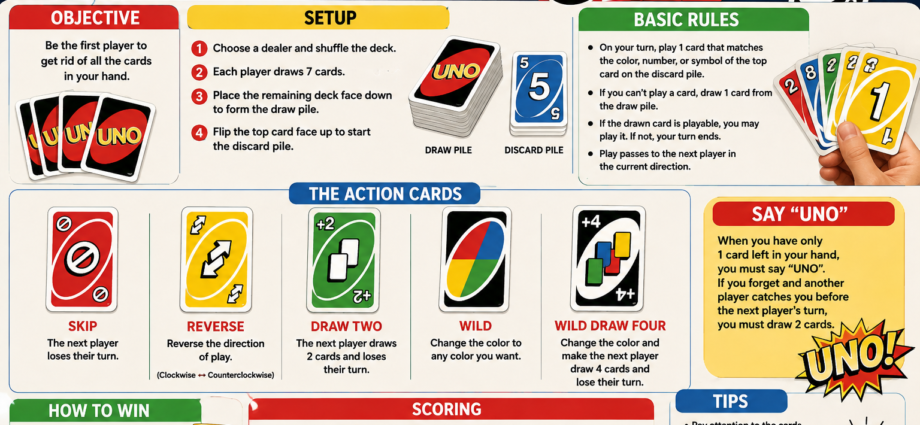
UNO is one of the most popular and easy-to-learn card games in the world. It can be played with family, friends, children, or larger groups, and a typical game can be completed relatively quickly. The basic objective is simple: get rid of all the cards in your hand before the other players do.
However, while UNO has simple basic rules, special cards, stacking rules, challenges, scoring, and house rules can sometimes make the game confusing for new players.
If you have never played UNO before, don’t worry. This guide explains how to play UNO step by step, including how to set up the game, what every card does, how to win, how scoring works, and useful strategies that can improve your chances of beating your opponents.
What Is UNO?
UNO is a color- and number-matching card game designed for multiple players. The game uses a specially designed deck containing colored number cards and several special action cards.
The main colors in a standard UNO deck are:
- Red
- Yellow
- Green
- Blue
Players take turns matching a card from their hand with the card currently at the top of the discard pile.
A card can generally be played if it matches the color, number, or symbol of the card on the discard pile.
For example, if the top card is a red 7, you can play:
- Any red card
- Any 7
- A Wild card
- A Wild Draw Four card, when legally playable
The goal is to be the first player to play every card in your hand.
How Many Players Can Play UNO?
UNO can normally be played by 2 to 10 players, depending on the edition and deck being used.
The game works well with:
- 2 players
- 3 players
- 4 players
- 5 or more players
Four players is particularly popular because turns move quickly while there are still enough opponents to make the game unpredictable.
With more players, the game can become chaotic because the color and direction can change frequently.
What Is Included in an UNO Deck?
A standard UNO deck contains several types of cards.
The exact contents can vary between different UNO editions, but the classic deck generally includes:
Number Cards
These cards are numbered from 0 through 9 and appear in four colors:
- Red
- Yellow
- Green
- Blue
Action Cards
The classic action cards include:
- Skip
- Reverse
- Draw Two
Wild Cards
Wild cards allow players to change the current color.
Common Wild cards include:
- Wild
- Wild Draw Four
Some newer UNO editions may contain additional special cards, so always check the instructions included with your particular deck.
How to Set Up an UNO Game
Setting up UNO only takes a few minutes.
Step 1: Choose a Dealer
Select one player to shuffle and deal the cards.
The dealer can be chosen randomly, or everyone can draw a card and the person with the highest number becomes the dealer.
Step 2: Shuffle the Cards
Shuffle the entire UNO deck thoroughly.
UNO contains different colors and card types, so good shuffling helps ensure that no player receives an unusually strong or weak starting hand.
Step 3: Deal Seven Cards
Each player receives seven cards.
Players should keep their cards hidden from everyone else.
You can hold your cards in your hand or place them in a card holder if you have one.
Step 4: Create the Draw Pile
Place the remaining cards face down in the middle of the table.
This becomes the draw pile.
Step 5: Create the Discard Pile
Turn the top card of the draw pile face up next to it.
This begins the discard pile.
Players will place their played cards on this pile during the game.
If the first card is a special action card, follow the rules for the particular UNO edition. Some editions use special procedures for the opening card.
How to Start Playing UNO
After the cards are dealt and the discard pile has been created, play begins.
The player to the dealer’s left traditionally goes first, although some editions or house rules may use another starting method.
On your turn, look at the card on top of the discard pile.
You need to play a card that matches it by:
- Color
- Number
- Symbol or action
For example, imagine the discard pile shows a blue 5.
You could play:
- A blue 2
- A blue 9
- A red 5
- A green 5
- A yellow 5
- A blue Skip
- A blue Reverse
- A blue Draw Two
- A Wild card
You cannot normally play an unrelated card such as a red 8.
What Happens If You Cannot Play a Card?
If you don’t have a playable card, you must draw a card from the draw pile according to the standard rules.
If the card you draw is playable, you may play it during that turn.
If it is not playable, your turn normally ends.
Some players use house rules that allow players to continue drawing until they find a playable card, but that is not the standard approach.
This distinction is important because house rules can significantly change the speed and strategy of the game.
UNO Card Meanings Explained
Understanding the special cards is essential if you want to play UNO correctly.
Let’s look at each important card.
Number Cards
Number cards are the simplest cards in UNO.
They come in four colors and are numbered from 0 to 9.
You can play a number card when it matches either:
- The color of the top discard card
- The number of the top discard card
For example, if the discard pile shows a green 8, you can play a red 8 because the number matches.
You could also play a green 2 because the color matches.
Number cards do not have special effects.
Skip Card
The Skip card causes the next player to lose their turn.
For example:
- Player 1 plays Skip.
- Player 2 is skipped.
- Player 3 takes the next turn.
The Skip card can be played when it matches the current color or when another applicable rule allows it.
Skip cards become especially useful when another player has only one or two cards remaining.
Reverse Card
The Reverse card changes the direction of play.
If players are currently taking turns clockwise, playing Reverse changes the direction to counterclockwise.
For example:
Player A → Player B → Player C → Player D
After Reverse:
Player A → Player D → Player C → Player B
With only two players, Reverse has a special effect in standard UNO rules: it effectively functions like a Skip, meaning the player who played it gets another turn.
Draw Two Card
The Draw Two card forces the next player to draw two cards and lose their turn.
For example:
- You play a red Draw Two.
- The next player draws two cards.
- That player misses their turn.
- Play continues to the following player.
Draw Two cards are powerful because they both increase an opponent’s hand and prevent them from immediately playing a card.
Wild Card
The Wild card gives the player control over the color.
When you play a Wild card, you choose the color that the next player must follow.
For example, suppose the current discard card is green.
You play a Wild card and announce:
“Red.”
The next player must now play a red card or another card that is legally playable under the game’s rules.
Wild cards are extremely useful because they allow you to change the color to one that works well with your hand.
Wild Draw Four Card
The Wild Draw Four is one of the strongest cards in UNO.
When played legally, it allows you to:
- Change the color.
- Make the next player draw four cards.
- Cause the next player to lose their turn.
However, there is an important restriction.
Under the standard rules, you should only play a Wild Draw Four when you do not have another card matching the current color.
For example, if the current color is red and you have a red 7, you should not normally play Wild Draw Four simply because you want to make another player draw four cards.
You may have other cards that don’t match the color, but having a matching-color card makes the Wild Draw Four play illegal under the standard rule.
What Does “UNO” Mean?
The word “UNO” means one.
This becomes important when you have only one card remaining.
When you play a card and are left with exactly one card in your hand, you must say:
UNO!
This tells the other players that you have only one card left.
If you forget to say UNO and another player catches you before the next player begins their turn, you can receive a penalty under the standard rules.
The exact penalty can depend on the edition’s official rules, but the classic game generally requires the player who failed to call UNO to draw two cards.
How Do You Win UNO?
There are two common ways people play UNO.
Simple Winner Method
The easiest method is to play until one person gets rid of all their cards.
The first player with zero cards wins the round.
This is a great method for casual games because it is simple and quick.
Scoring Method
UNO can also be played over multiple rounds using points.
When one player gets rid of all their cards, they receive points based on the cards remaining in their opponents’ hands.
The goal is to reach the target score established by the game’s rules.
Many classic UNO games use 500 points as the overall winning target.
However, scoring systems can vary between editions and house rules.
How UNO Scoring Works
When a player wins a round, they receive points for the cards still held by their opponents.
Number cards are normally worth their face value.
For example:
- 3 = 3 points
- 7 = 7 points
- 9 = 9 points
Action cards have higher values.
Typical classic values include:
- Skip = 20 points
- Reverse = 20 points
- Draw Two = 20 points
- Wild = 50 points
- Wild Draw Four = 50 points
Always check the rules included with your particular UNO deck because newer versions can introduce different cards and scoring systems.
A Simple Example of an UNO Turn
Imagine four players are playing:
- Alex
- Sarah
- Mike
- David
The top discard card is yellow 6.
Alex is next.
Alex has:
- Red 6
- Blue 3
- Yellow 9
- Green 2
- Wild
- Red Skip
- Blue 7
Alex can play:
- Red 6 because the number matches.
- Yellow 9 because the color matches.
- Wild because it can change the color.
Alex chooses the Red 6.
The top card is now red 6.
Sarah must now play a red card, another 6, or a suitable Wild card.
This process continues until someone gets rid of all their cards.
UNO Strategy: How to Improve Your Chances of Winning
UNO is easy to learn, but winning consistently requires some strategy.
Here are several useful techniques.
1. Pay Attention to Colors
Always watch which colors your opponents are playing.
If someone repeatedly draws cards when the color is blue, they may not have many blue cards.
That can give you useful information.
2. Save Wild Cards
Don’t automatically play your Wild cards whenever they are available.
A Wild can be extremely valuable near the end of the round.
If you have only one or two cards remaining, changing the color to one that matches your final card can help you finish.
3. Use Action Cards Carefully
Skip, Reverse, and Draw Two cards can be more valuable than ordinary number cards.
If an opponent has only two cards left, a Skip or Draw Two could prevent them from reaching UNO and winning.
4. Watch the Player With the Fewest Cards
You should always know which opponent is closest to winning.
If another player has six cards, they are usually less dangerous than someone holding two cards.
When an opponent gets down to two or three cards, consider using your strongest action cards against them.
5. Don’t Always Choose the Same Color
When you play a Wild card, think about your remaining cards.
Suppose you have:
- Red 4
- Red 8
- Red Skip
- Wild
Choosing red may be much better than choosing blue or green.
Changing the color strategically can allow you to play multiple cards on future turns.
6. Remember What Other Players Draw
If a player repeatedly draws cards when the current color is yellow, remember that.
Later, if you have a Wild card, choosing yellow could force that player into another difficult situation.
UNO rewards players who pay attention.
7. Get Rid of High-Value Cards
If you’re playing with scoring, high-value cards can become dangerous if another player goes out.
A Wild Draw Four is worth many more points than a regular number card.
If you have an opportunity to safely play expensive cards before the round ends, consider doing so.
Common UNO Mistakes Beginners Make
New players often make the same mistakes.
Mistake 1: Forgetting to Say UNO
When you have one card left, say “UNO.”
It’s easy to forget when the game becomes fast.
Mistake 2: Playing Wild Draw Four Illegally
The Wild Draw Four has a specific restriction under the standard rules.
Don’t play it simply because it is convenient if you have a card matching the current color.
Mistake 3: Ignoring Opponents
UNO is not only about managing your own hand.
Watch what other players do.
Their discarded cards and drawing behavior can give you valuable information.
Mistake 4: Wasting Powerful Cards
Using a Wild or Draw Two without considering the situation can leave you without an important card when you need it most.
Mistake 5: Confusing House Rules With Official Rules
Many families and friend groups have their own UNO rules.
For example, some groups allow Draw Two cards to be stacked.
Others allow Wild Draw Four cards to be stacked.
These rules can be fun, but they are not necessarily part of the standard rules.
Can You Stack Draw Two Cards?
This is one of the biggest UNO debates.
Many players are familiar with the rule where one player plays a Draw Two and the next player responds with another Draw Two.
The penalty then becomes four cards.
However, stacking is commonly treated as a house rule rather than part of the classic standard rules.
If you want to use stacking, agree on the rule before starting the game.
This avoids arguments later.
Can You Stack Wild Draw Four Cards?
The same issue applies to Wild Draw Four cards.
Some groups allow players to respond with another Draw Four.
Others do not.
If you’re playing according to standard rules, don’t assume that stacking is automatically permitted just because your friends normally play that way.
Before starting a game, establish which rule set everyone is following.
UNO House Rules
House rules are one reason UNO can feel different from one group to another.
Popular house rules include:
Draw Until You Can Play
Instead of drawing only one card, players continue drawing until they find a playable card.
Stacking
Players can respond to Draw cards with another Draw card.
Jump-In
A player can immediately play a matching card even when it is not their turn, depending on the agreed rule.
Seven-O
Some groups create special effects when players play a 7 or 0.
These rules can make games faster or more chaotic, but they should be agreed upon before playing.
UNO Tips for Playing With Kids
UNO is popular with families because the basic matching system is easy to understand.
When teaching children, start with the simplest version of the rules.
Explain:
- Everyone gets seven cards.
- Match the color or number.
- Special cards have special effects.
- Draw when you cannot play.
- Say UNO when you have one card left.
- The first person with no cards wins.
Once children understand the basic game, you can introduce scoring and more advanced strategies.
UNO Tips for Larger Groups
UNO becomes particularly unpredictable with many players.
When playing with a large group, keep your cards organized so other players cannot see them.
Pay attention to the direction of play because Reverse cards can quickly change who takes the next turn.
Also keep track of players who have only a few cards.
A player with one card can potentially win suddenly, so don’t become too focused on your own hand.
Is UNO a Game of Luck or Strategy?
UNO contains both luck and strategy.
The cards you receive are determined largely by chance, so a player can sometimes receive an excellent hand while another player receives difficult cards.
However, players still make meaningful decisions.
You must decide:
- Which card to play
- When to change colors
- Whether to save Wild cards
- When to use action cards
- Which opponent to target
- Whether to take risks
This combination of luck and decision-making is one reason UNO appeals to so many different players.
A beginner can understand the game within minutes, while experienced players can develop more sophisticated strategies over time.
How Long Does a Game of UNO Take?
A single UNO round can be relatively short, but the exact duration depends on the number of players and how many cards are drawn.
A casual game may take around 5 to 15 minutes per round, although some rounds can last considerably longer.
If you play to a larger scoring target, the complete game can take much longer.
For a quick family game, playing a single round is usually enough.
For competitive groups, playing multiple rounds and keeping score adds another layer of challenge.
Why Is UNO So Popular?
UNO has remained popular for decades because it combines simplicity with unpredictability.
You don’t need complicated instructions or a large playing area.
You can play it at a kitchen table, during a family gathering, on vacation, or with friends.
The rules are easy enough for children to understand, but special cards and strategic decisions keep adults interested.
Another major advantage is that games can change dramatically in seconds.
A player may be one card away from victory, only to receive a Draw Four and suddenly have five cards.
That unpredictability creates memorable moments and plenty of friendly competition.
Final Thoughts
Learning how to play UNO is simple. Start by dealing seven cards to each player, place the remaining deck in the center, and turn one card face up to create the discard pile.
On each turn, play a card that matches the current color, number, or symbol. If you cannot play, draw a card according to the standard rules. Use Skip, Reverse, Draw Two, Wild, and Wild Draw Four cards strategically to influence the game.
Most importantly, remember to say UNO when you have only one card remaining.
Although the basic rules are easy, UNO becomes much more interesting when you start paying attention to your opponents, managing your colors, saving Wild cards, and timing your action cards.
Whether you’re teaching UNO to your family for the first time or looking to improve your strategy, the best way to learn is simply to start playing.
Once everyone understands the basic rules, you can decide whether you want to use standard rules or add your favorite house rules for a more chaotic game.
UNO’s combination of simple mechanics, quick turns, strategy, luck, and unexpected reversals is exactly what makes it such a timeless card game.
Frequently Asked Questions About UNO
How many cards does each player get in UNO?
Each player normally receives seven cards at the beginning of the game.
What happens when you cannot play a card?
Under the standard rules, you draw one card from the draw pile. If that card is playable, you may play it; otherwise, your turn ends.
When do you say UNO?
You must say “UNO” when you play a card that leaves you with exactly one card in your hand.
Can you play UNO with two people?
Yes. UNO can be played with two players, although some action cards have slightly different effects in a two-player game.
Can you stack Draw Two cards?
Stacking Draw Two cards is a popular house rule, but it should not be assumed to be part of the standard rules. Agree on your rules before starting.
What is the strongest UNO card?
The Wild Draw Four is one of the most powerful cards because it lets you change the color while forcing the next player to draw four cards and lose their turn. However, it has specific conditions for legal play.
How do you win UNO?
The simplest method is to be the first player to get rid of every card in your hand. You can also play multiple rounds using a points-based scoring system.
Is UNO suitable for children?
Yes. UNO is generally easy for children to learn, especially when starting with the basic matching rules before introducing more advanced strategies and scoring.